


By Dr. Liyan Massaband, DMD, MPH · Last updated: 1 Oct 2026
Quick answer: If your tooth can be saved, a root canal with a crown is usually the better first choice. It keeps your natural tooth, costs less, takes weeks instead of months and has a much easier recovery. A dental implant is the better choice when the tooth cannot be predictably saved: a crack running down the root, too little tooth left to hold a crown, severe bone loss around it, or a root canal that has already failed more than once. The right answer depends on the tooth, not the procedure, so the decision should start with a proper exam and X-rays.
Key takeaways
- Save the tooth if you can. The American Association of Endodontists calls saving your natural tooth with a root canal the preferred option whenever it is possible.
- A root canal and crown usually cost about half of an extraction plus an implant.
- A root canal takes 1 to 2 visits. An implant takes several visits over 3 to 6 months or more.
- Both can last for decades when they are the right choice for the tooth.
- An implant is not a “better tooth.” It is the best replacement once a tooth cannot be kept.
“Should I just pull it and get an implant?” is a question I hear almost every week. Patients often assume an implant is the more permanent or more modern option. Sometimes it is the right call. But a natural tooth with healthy roots and enough structure left is still the best tooth you will ever have, and keeping it is usually simpler, faster and less expensive. Here is how I help patients weigh the two.
Root Canal vs Dental Implant at a Glance
| Root canal and crown | Dental implant | |
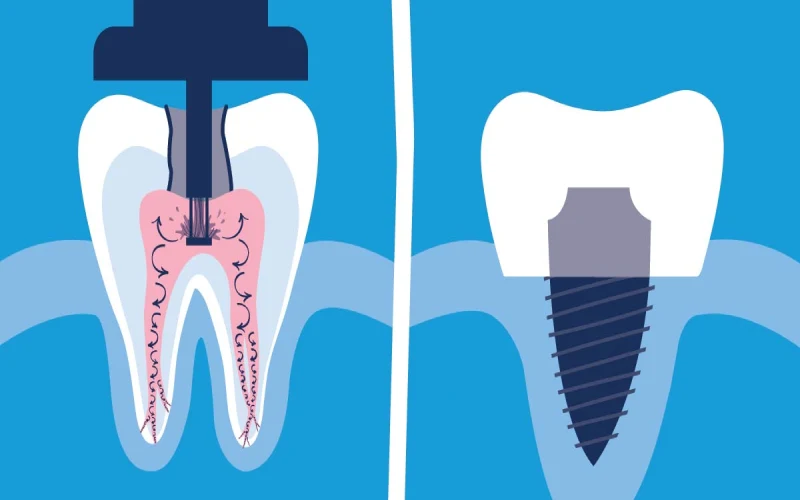
| What it does | Cleans out infected pulp and keeps your own tooth | Removes the tooth and replaces the root with a titanium or zirconia post |
| Typical cost in Beverly Hills | About $1,900 to $3,500 (root canal plus crown) | About $4,500 to $7,500, plus extraction and any bone graft |
| Number of visits | 1 to 2 for the root canal, 1 to 2 for the crown | Several over 3 to 6 months, longer with grafting |
| Time until you can chew normally | Days to a couple of weeks | Usually after the final crown, 3 to 6 months |
| Recovery | Mild soreness for a few days | Swelling and soreness for about a week, then months of bone healing |
| Surgery needed | No | Yes, plus an extraction |
| Feels like | Your own tooth, with normal feedback when you bite | Very close to a natural tooth, but without the ligament cushion |
| Can get a cavity | Yes, so brushing and flossing still matter | No, but the gums and bone can get infected (peri-implantitis) |
| Best for | A restorable tooth with healthy bone around it | A tooth that cannot be saved, or a missing tooth |
What Is a Root Canal?
A root canal removes the infected or inflamed nerve tissue (the pulp) from inside a tooth, disinfects the canals and seals them. The tooth then gets a crown, especially if it is a back tooth, to protect it from cracking. You keep your natural root, your gum attachment and the ligament that cushions the tooth in the bone.
The American Association of Endodontists explains that saving your natural tooth helps you keep normal chewing and stops neighbouring teeth from drifting. You can read how we approach it on our root canal therapy page.
Signs you may need one: lingering pain to hot or cold, a toothache that wakes you at night, a darkening tooth, or a pimple on the gum. Our guide to the signs you need a root canal covers these in detail.
What Is a Dental Implant?
A dental implant replaces a tooth that has been removed. A small post is placed into the jawbone, the bone fuses to it over a few months, and then an abutment and crown are attached. It does not depend on neighbouring teeth for support, and it cannot decay.
The trade-offs are surgery, a longer timeline and higher cost. Cleveland Clinic notes it can take three to nine months for the jaw to fuse around the implant before the final tooth goes on. See our dental implants page for how we plan treatment.
The Real Question: Can Your Tooth Be Saved?
The choice between a root canal and an implant is not about which treatment is better in general. It is about whether this specific tooth has a good long-term outlook. These are the four things I check.
- How much healthy tooth is left above the gum. A crown needs something solid to grip. If decay or a fracture has destroyed most of the tooth down to or below the gum line, it may not hold a crown reliably, even after a root canal.
- Where the crack is. A crack limited to the crown of the tooth can often be treated. A vertical root fracture, a crack running down the root, usually cannot. That tooth is generally better replaced.
- How much bone and gum support remains. If gum disease has destroyed much of the bone around the root, the tooth may stay loose even after a perfect root canal.
- Whether it has been treated before. A failed root canal can often be redone with endodontic retreatment. But if a tooth has already been retreated and is still infected, or the root is perforated, an implant is often the more predictable option.
A 3D cone beam scan (CBCT) shows cracks, hidden infection and bone levels that a regular X-ray can miss. It is one of the most useful tools for making this decision well.
When a Root Canal Is the Better Choice
- The tooth has enough healthy structure to hold a crown.
- There is no crack running into the root.
- The bone and gums around it are healthy.
- It is a front tooth, where keeping your own gum line gives the most natural look.
- You want to avoid surgery, or a health condition makes surgery riskier.
- You need the tooth working again quickly.
- Cost is a major factor.
When a Dental Implant Is the Better Choice
- The tooth has a vertical root fracture.
- Too little tooth is left to support a crown, even with a post and build-up.
- There is severe bone loss around the root.
- A root canal has failed and retreatment is unlikely to work.
- The tooth would need a root canal, gum surgery and crown lengthening just to be kept, with a guarded outlook at the end.
- The tooth is already missing.
If an implant is the plan, it starts with an extraction. Our surgical extractions page explains how we remove teeth while protecting the bone, and in some cases an implant can be placed the same day.
How Does the Cost of a Root Canal Compare to the Cost of a Dental Implant?
A root canal with a crown usually costs roughly half as much as an extraction followed by an implant, abutment and crown. In Beverly Hills, a root canal and crown typically come to about $1,900 to $3,500, while a single implant with its crown typically comes to about $4,500 to $7,500 before any extraction or bone graft.
| Cost item | Root canal route | Implant route |
| Root canal | $700 to $1,500 (front tooth to molar) | Not needed |
| Crown | $1,200 to $2,000 | Implant crown included in total below |
| Extraction | Not needed | $150 to $400 |
| Bone graft (if needed) | Not needed | $500 to $3,000 |
| Implant, abutment and crown | Not needed | $4,500 to $7,500 |
| Typical total | About $1,900 to $3,500 | About $4,650 to $7,900, or up to about $10,900 with a bone graft |
These are typical ranges, not a quote. Your exact cost depends on the tooth, the materials and what your exam shows.
Insurance: dental plans usually cover part of a root canal and crown. Many plans cover less of an implant, or none of it. See understanding dental insurance and our payment options. For a full breakdown of implant pricing, read how much do dental implants cost in Beverly Hills.
The long view: a root canal tooth may one day need a new crown, and an implant may one day need a new crown or repairs. Choosing a root canal for a tooth with a poor outlook can cost more over time if it later fails and needs an implant anyway. Choosing an implant for a tooth that could have been saved costs more from day one.
Recovery: Root Canal vs Implant
After a root canal
- Numbness wears off within a few hours.
- Mild soreness for 2 to 4 days, usually managed with over the counter pain relief.
- Most people go back to work the same day or the next.
- The permanent crown is usually placed within a few weeks.
Some soreness is normal. If you notice swelling, read our guides to swelling after a root canal and signs of infection after a root canal.
After an implant
- Swelling and soreness peak around day 2 or 3 and settle over a week.
- A soft diet for the first couple of weeks, then chewing on the other side.
- 3 to 6 months of bone healing before the final crown, longer with a graft.
Our guide on how long dental implants take to heal walks through each stage.
Which Hurts More, a Root Canal or an Implant?
Modern root canals are done under local anaesthetic and usually feel much like a long filling. The AAE reports that patients who have a root canal are far more likely to describe it as painless than patients who have a tooth pulled. An implant involves an extraction and a minor surgery, so most people have more swelling and soreness in the first week. Neither should be severely painful with good anaesthetic and aftercare.
Which Lasts Longer?
Both can last for decades when they are the right treatment for the tooth.
- A root canal tooth with a good crown, healthy gums and no cracks can last a lifetime. The main risks are new decay under the crown and fractures, which is why the crown matters so much.
- An implant cannot decay, but it can be lost to peri-implantitis, heavy grinding or smoking. The crown on top may need replacing after many years.
In other words, longevity depends far more on choosing the right option for the tooth, and caring for it, than on which treatment you pick.
Other Factors That Can Tip the Decision
- Smoking and diabetes raise the risk of implant problems and slow healing, which can favour keeping the tooth.
- Grinding (bruxism) puts heavy force on both. A root canal tooth may crack, and an implant may overload. A custom night guard protects either one.
- Front teeth: keeping the natural tooth often gives the best gum line and appearance.
- Back teeth with very short or curved roots can be harder to treat with a root canal.
- Timing: if you need to chew normally soon, a root canal is much faster.
- Age and growth: implants are not placed in growing jaws, so teenagers usually keep the tooth if at all possible.
What If I Do Nothing, or Just Pull the Tooth?
Leaving an infected tooth untreated can let the infection spread, cause an abscess and, in some cases, serious facial swelling. Removing a tooth and not replacing it lets the bone in that area shrink over time and lets nearby teeth drift or tip into the gap, which can change your bite. If you are weighing simply removing the tooth, read root canal vs tooth extraction first. Other replacements include a dental bridge or a partial denture.
Questions to Ask Your Dentist Before You Decide
- Can this tooth be saved, and what is its outlook in 10 years?
- Is there a crack, and does it reach the root?
- Will I need a post, build-up or crown lengthening to keep it?
- If I choose an implant, will I need a bone graft or sinus lift?
- What is the total cost of each option, including the crown?
- What does my insurance cover for each?
- If you are recommending extraction, would a second opinion be reasonable?
A good dentist will welcome these questions. If you have been told a tooth must come out and you are not sure, a second opinion is always reasonable.
Getting a Second Opinion in Beverly Hills
At ConfiDental Beverly Hills, we start with a comprehensive dental exam and 3D imaging, then walk you through the honest outlook for your tooth. If it can be saved, we will tell you. If an implant is the more predictable choice, we will explain why and plan each step, from extraction to your final porcelain crown.
Not sure which option is right for you? Book a consultation or call (310) 858-9212. Our office is at 9615 Brighton Way #222, Beverly Hills, CA 90210. If you are in pain right now, see our emergency dentist page.
Frequently Asked Questions
Is it better to get a root canal or an implant?
If the tooth can be saved with a good long-term outlook, a root canal and crown is usually better. It keeps your natural tooth, costs less and heals faster. An implant is better when the tooth has a root fracture, too little structure left, severe bone loss or a root canal that has already failed.
How does the cost of a root canal compare to the cost of a dental implant?
A root canal and crown usually cost about half as much as an implant. In Beverly Hills, a root canal with a crown typically costs about $1,900 to $3,500, while an extraction plus a single implant and crown typically costs about $4,650 to $7,900, and more if a bone graft is needed.
Is a root canal or implant more painful?
Most people find a root canal less painful. It is done with local anaesthetic and feels similar to a long filling, with a few days of mild soreness. An implant involves an extraction and minor surgery, so there is usually more swelling and soreness in the first week.
Does a root canal or implant last longer?
Both can last for decades. A root canal tooth with a well fitting crown can last a lifetime, and so can an implant. Which one lasts longer for you depends on the condition of the tooth, your gums, your bite and how well you look after it.
Can I get an implant after a failed root canal?
Yes. If a root canal fails and retreatment is not likely to work, the tooth can be removed and replaced with an implant. Sometimes the implant can go in the same day as the extraction, and sometimes the area needs a few months to heal or a bone graft first.
Should I pull my tooth instead of getting a root canal?
Usually not, if the tooth can be saved. Keeping your natural tooth avoids surgery, protects the bone and keeps neighbouring teeth from shifting. Extraction makes sense when the tooth cannot be predictably restored.
How do I know if my tooth can be saved?
Your dentist checks how much healthy tooth is left, whether there is a crack in the root, the health of the bone and gums around it, and whether it has been treated before. A 3D scan helps show cracks and infection that regular X-rays may miss.
Does insurance cover a root canal or an implant?
Most dental plans cover part of a root canal and crown. Implant coverage varies widely, and some plans cover little or none of it. Our team can check your benefits before you decide.
Is a root canal tooth weaker than a natural tooth?
A tooth that has had a root canal, especially a back tooth, can be more brittle because it often lost structure to decay or old fillings. A crown protects it from cracking, which is why most back teeth need one after a root canal.
If I grind my teeth, which is better?
Grinding puts heavy force on both a root canal tooth and an implant. The best option still depends on the tooth itself. Either way, wearing a custom night guard protects your treatment and your other teeth.
About the Author
Dr. Liyan Massaband, DMD, MPH leads ConfiDental Beverly Hills. She earned her Doctor of Dental Medicine from Midwestern University and her Master of Public Health from the University of Southern California. In more than 15 years of practice she has completed over 1,000 implant procedures and focuses on full-mouth restoration, complex cases and prevention-first care.
References
- American Association of Endodontists. Root Canal vs. Dental Implant: Which Is Right for You?
- American Association of Endodontists. Saving Your Natural Tooth.
- American Association of Endodontists. Endodontic Retreatment.
- Cleveland Clinic. Dental Implants: Surgery, Advantages, Risks and Recovery.
This article is for general education and does not replace a dental examination. Costs are typical ranges, not a quote.