


By Dr. Liyan Massaband, DMD, MPH · Last updated: 1 Oct 2026
Quick answer: In Beverly Hills, a single dental implant with its abutment and crown typically costs $4,500 to $7,500. Replacing two or three teeth with an implant bridge typically costs $7,000 to $14,000. All-on-4 usually costs $20,000 to $35,000 per arch, and full mouth implants for both arches usually cost $40,000 to $80,000 or more. Extractions, bone grafts and sinus lifts are added only if you need them. These ranges are typical for Beverly Hills and the wider Los Angeles area, but your exact cost depends on your bone, the number of teeth and the materials, so a personal quote always comes after an exam and 3D scan.
Key takeaways
- Ask for the all-in price: implant, abutment, crown, imaging and any surgery you need.
- Bone grafting and extractions are the most common add-ons.
- Insurance often covers part of an implant, usually the crown, up to an annual maximum.
- HSA and FSA money can usually be used for implants.
- The cheapest quote is not always the lowest cost over 10 or 20 years.
Cost is the first question almost every implant patient asks me, and it deserves a straight answer. The problem with many “implant cost” pages is that they quote a low number for the post alone, and the patient only discovers the abutment, crown and grafting fees later. Below, I break the price into its parts so you know exactly what a fair quote should include.
Dental Implant Cost in Beverly Hills at a Glance
| Treatment | Typical cost in Beverly Hills | Best for |
| Single tooth implant (implant, abutment and crown) | $4,500 to $7,500 | One missing or failing tooth |
| Several individual implants | $4,500 to $7,500 per tooth | Missing teeth in different areas |
| Implant-supported bridge (2 implants carrying 3 or 4 teeth) | $7,000 to $14,000 | Two to four missing teeth in a row |
| Implant overdenture (2 implants, snap-in) | $6,000 to $15,000 per arch | Stabilising a loose denture |
| Implant overdenture (4 implants, snap-in) | $10,000 to $20,000 per arch | Firmer support for a removable denture |
| All-on-4 (fixed full arch) | $20,000 to $35,000 per arch | Replacing all teeth in one jaw |
| All-on-6 (fixed full arch) | $24,000 to $40,000 per arch | Full arch with extra support |
| Full mouth implants (both arches) | $40,000 to $80,000+ | Replacing all upper and lower teeth |
Possible add-ons
| Add-on | Typical cost | When it is needed |
| Consultation and 3D CBCT scan | $150 to $350 (sometimes credited toward treatment) | Every implant plan |
| Tooth extraction | $150 to $400 per tooth | If the tooth is still there |
| Bone graft | $500 to $3,000 | Thin or shrunken bone |
| Sinus lift | $1,500 to $3,500 | Upper back teeth near the sinus |
| Sedation | Varies with the type and length | If you prefer to be more relaxed |
These are typical ranges, not a quote. A personal estimate is given after your exam and imaging.
What Is Included in the Cost of a Dental Implant?
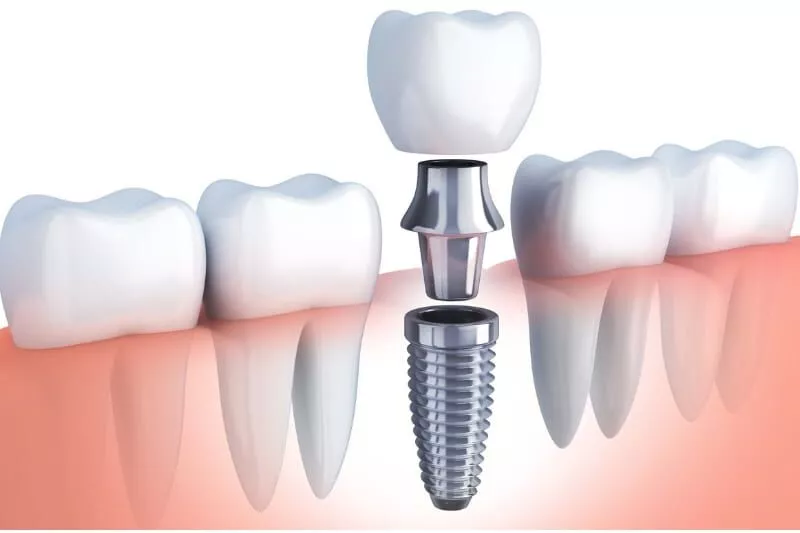
A dental implant is not one item. It is three parts plus the planning and surgery to place them.
| Part or step | What it is | Typical share of a single tooth cost |
| Implant post | Titanium or zirconia root placed in the jaw | $1,500 to $3,000 |
| Abutment | Connector between post and crown | $500 to $1,000 |
| Implant crown | The visible tooth, usually porcelain or zirconia | $1,200 to $2,500 |
| Planning | Exam, 3D scan, digital design, surgical guide | Often included or charged at consultation |
The American Association of Oral and Maxillofacial Surgeons notes that a single implant can start at around $1,500, but that the total depends on extractions, anaesthesia, bone grafting, imaging and the crown. That is why a quote that only lists the post can look far cheaper than it really is.
Before you compare quotes, check that each one includes:
- The implant post and the abutment
- The final crown, and what it is made of
- Any temporary tooth while you heal
- 3D imaging and the surgical guide
- Extraction and bone graft, if needed
- Follow-up visits during healing
What Affects How Much Dental Implants Cost?
- How many teeth you are replacing. Two implants can often support a bridge of three or four teeth, which costs less than an implant for every tooth.
- Your bone. If a tooth has been missing for a while, the bone shrinks. A graft or sinus lift adds cost and a few months of healing. Replacing a tooth sooner often avoids this.
- Which tooth. Front teeth need more careful aesthetic work. Upper back teeth may need a sinus lift.
- Materials. Zirconia crowns and zirconia full arch bridges cost more than acrylic or porcelain fused to metal, but are stronger and more stain resistant. Zirconia (metal-free) implant posts are usually priced higher than titanium.
- The implant system. Established implant brands with long research records, and genuine parts that can be replaced years later, cost more than generic systems.
- Technology. 3D CBCT imaging and guided surgery add to the planning cost but improve accuracy.
- Preparatory treatment. Gum disease or decay elsewhere in the mouth must be treated first. A deep dental cleaning or treatment of gum disease may be part of the plan.
- Location. Dental implant costs in Beverly Hills and Los Angeles tend to be higher than national averages because of practice costs, lab quality and the level of imaging and planning involved.
Single Tooth Implant Cost
For most people replacing one tooth, the all-in cost is $4,500 to $7,500, including the implant, abutment and crown. Add an extraction or bone graft if needed. Our single tooth dental implant cost guide breaks this down step by step, and the implant restoration page explains the crown stage.
All-on-4 and Full Mouth Dental Implants Cost
All-on-4 uses four implants to hold a fixed bridge of 10 to 14 teeth in one jaw. In Beverly Hills it typically costs $20,000 to $35,000 per arch. All-on-6 typically costs $24,000 to $40,000 per arch. Full mouth implants for both jaws typically cost $40,000 to $80,000 or more.
What moves the price within that range:
- Final bridge material: acrylic is less expensive; zirconia costs more but lasts longer and resists chipping and staining.
- Extractions and bone work needed on the day of surgery.
- Temporary teeth fitted the same day.
- Sedation for a longer procedure.
Learn more on our All-on-4 dental implants and full mouth restoration pages. If you wear a denture today, an implant overdenture can be a lower-cost way to stop it from slipping.
Implants vs Bridges vs Dentures: Cost Over Time
| Dental implant | Dental bridge | Removable denture | |
| Upfront cost | Highest | Moderate | Lowest |
| Affects neighbouring teeth | No | Yes, they are shaved for crowns | Clasps can wear nearby teeth |
| Protects jawbone | Yes | No | No, bone keeps shrinking |
| Typical lifespan | Post often lifelong, crown many years | Often 10 to 15 years | Often 5 to 10 years, with relines |
| Ongoing costs | Checkups, occasional crown replacement | Replacement bridge, possible root canals on support teeth | Relines, repairs, replacement |
A dental bridge or denture costs less on day one. Over 15 to 20 years, the difference often narrows, because bridges and dentures usually need replacing and an implant post does not. Our comparison of dental implants vs dentures and our guide to the lifespan of denture implants go into more detail.
If your tooth is still there, saving it may cost less than replacing it. See root canal vs implant for a side by side cost comparison.
Does Insurance Cover Dental Implants?
Sometimes, partly. Coverage depends entirely on your plan. The AAOMS explains that some dental plans cover implants and some do not, that annual maximums usually apply, and that medical insurance may cover part of the treatment in some situations, such as tooth loss from an accident.
What dental plans commonly do:
- Cover the crown at the major services rate, often around 50 percent.
- Cover extractions and sometimes bone grafts.
- Exclude the implant post, or cover it only after a waiting period.
- Cap total yearly benefits, often at $1,000 to $2,000.
A useful tip: because of annual maximums, staging treatment across two calendar years can let you use two years of benefits.
Our team checks your benefits before treatment. Read understanding dental insurance for more.
Can I use my HSA or FSA for dental implants?
Usually, yes. IRS Publication 502 lists dental treatment, including dentures and artificial teeth, as qualifying medical expenses, so implants generally qualify. Cosmetic-only treatment such as whitening does not. Check the rules of your own plan.
How to Afford Dental Implants
- HSA or FSA funds, as above.
- Dental insurance for the covered parts.
- CareCredit, a healthcare credit card that offers monthly payment plans for approved applicants.
- Phased treatment, for example placing implants now and the final teeth a few months later, or treating one area at a time.
- All major credit cards.
See all options on our payment options page.
Are Cheap Dental Implants Worth It?
A low price is worth questioning, not rejecting. Before choosing the cheapest quote, ask:
- Does the price include the abutment and crown, or only the post?
- Which implant brand is used, and can parts be sourced in 10 years?
- Is a 3D scan taken before surgery?
- Who places the implant and who makes the crown?
- What happens, and what does it cost, if something goes wrong?
Implants placed with little planning, in poor bone or with unknown parts are more likely to need costly repair later. If you are already having trouble with an implant, our guide to dental implant failure signs and causes and our implant complications page can help.
Is a Dental Implant Worth the Cost?
For many people, yes. An implant does not depend on neighbouring teeth, cannot get a cavity, helps preserve the jawbone, and lets you chew and smile normally. Cleveland Clinic notes that implants can last indefinitely with good care, while the crown or denture on top may need replacing over time.
It may not be the best value if the tooth can be saved, if you smoke heavily and cannot stop, or if health conditions make surgery riskier. An honest consultation should cover all of your options, not only implants.
From Consultation to Final Tooth: What You Pay For at Each Step
| Step | What happens | Typical timing |
| 1. Consultation | Exam, 3D scan, treatment options and written estimate | Day 1 |
| 2. Preparation | Extraction, bone graft or gum treatment, if needed | Weeks to months before |
| 3. Implant placement | Post placed, sometimes with a temporary tooth | Surgery day |
| 4. Healing | Bone fuses to the implant | 3 to 6 months |
| 5. Abutment and crown | Final tooth designed and fitted | After healing |
Our guide on how long dental implants take to heal explains the healing stage in detail.
Getting an Accurate Implant Quote in Beverly Hills
At ConfiDental Beverly Hills, every implant plan starts with a comprehensive dental exam and 3D imaging. You leave with a written, itemised estimate that shows each part of the treatment, what insurance is likely to cover, and the payment options available. We will also tell you honestly if a root canal, bridge or denture would serve you better.
Ready to find out your own cost? Book a consultation or call (310) 858-9212. Our office is at 9615 Brighton Way #222, Beverly Hills, CA 90210. Learn more about our approach on the dental implants page.
Frequently Asked Questions
How much do dental implants cost in Beverly Hills?
A single implant with its abutment and crown typically costs $4,500 to $7,500 in Beverly Hills. All-on-4 typically costs $20,000 to $35,000 per arch, and full mouth implants typically cost $40,000 to $80,000 or more. Extractions, bone grafts and sinus lifts are extra if needed.
How much are dental implants in Los Angeles?
Prices across Los Angeles are broadly similar to Beverly Hills, though they vary from office to office. When you compare, make sure each quote includes the implant, abutment and crown, because some advertised prices cover only the implant post.
Why are dental implants so expensive?
An implant involves surgery, a precision-made post and abutment, a custom crown, 3D imaging and several visits over a few months. You are paying for the parts, the planning, the surgery and the lab work, not just the post.
Does dental insurance cover implants?
It depends on your plan. Many plans cover part of the crown and the extraction, and some cover the implant post. Annual maximums usually limit how much is paid each year, so check your benefits before treatment.
Can I use HSA or FSA funds for dental implants?
Usually, yes. The IRS treats dental treatment and artificial teeth as qualifying medical expenses, so implants generally qualify. Check the rules of your specific plan.
How much does a bone graft add to implant cost?
A bone graft typically adds $500 to $3,000, depending on how much bone is needed and the material used. A sinus lift for upper back teeth typically adds $1,500 to $3,500.
Is All-on-4 cheaper than individual implants for a full arch?
Usually, yes. Replacing every tooth in an arch with its own implant would need many more implants and cost far more. All-on-4 uses four implants to support a full arch of teeth.
Are mini dental implants cheaper?
Mini implants are narrower and usually cost less. They are mainly used to stabilise a lower denture. They are not a good fit for every situation, especially single back teeth that take heavy biting forces.
Can I pay for dental implants monthly?
Yes. Financing such as CareCredit lets approved patients spread the cost into monthly payments, and treatment can often be staged over time. Our team can walk you through the options.
How long do dental implants last for the money?
With good care and regular checkups, the implant post often lasts a lifetime. The crown on top may need replacing after many years. That long lifespan is why implants can cost less over 20 years than options that need regular replacement.
About the Author
Dr. Liyan Massaband, DMD, MPH leads ConfiDental Beverly Hills. She earned her Doctor of Dental Medicine from Midwestern University and her Master of Public Health from the University of Southern California. In more than 15 years of practice she has completed over 1,000 implant procedures and focuses on full-mouth restoration, complex cases and prevention-first care.
References
- American Association of Oral and Maxillofacial Surgeons. How Much Are Dental Implants?
- American Association of Oral and Maxillofacial Surgeons. Does Insurance Cover Dental Implants?
- Internal Revenue Service. Publication 502: Medical and Dental Expenses.
- Cleveland Clinic. Dental Implants: Surgery, Advantages, Risks and Recovery.
Prices are typical ranges for Beverly Hills as of 2026 and are not a quote. Your personal estimate is given after an exam and imaging. This article is for general education and does not replace a dental consultation.