


By Dr. Liyan Massaband, DMD, MPH · Last updated: 1 Oct 2026
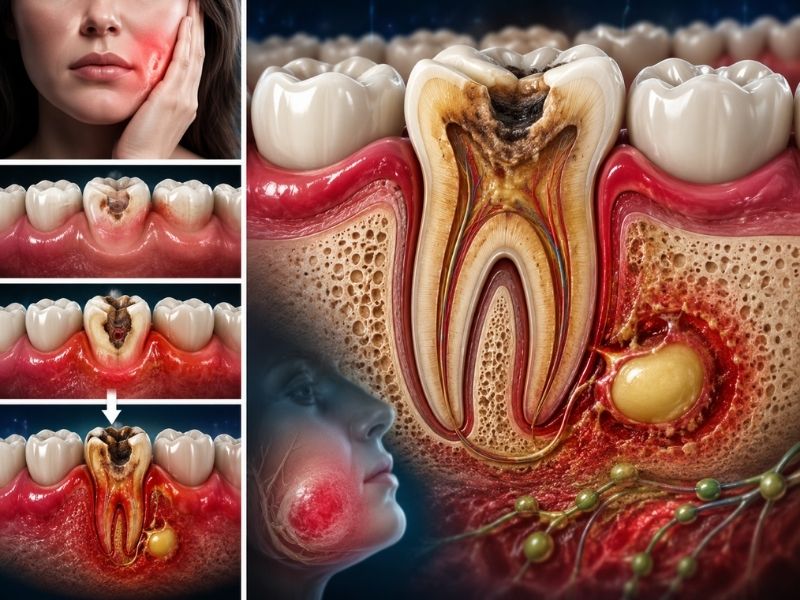
Quick answer: A tooth abscess is a pocket of pus caused by a bacterial infection inside a tooth or in the gum beside it. Common symptoms are a severe, throbbing toothache, pain when biting, a swollen gum or face, a pimple-like bump on the gum, a bad taste, and sometimes fever. An abscess does not heal on its own. It is treated by removing the source of infection, usually with a root canal, drainage or extraction. Antibiotics alone do not cure it. Swelling that spreads, fever, or trouble swallowing or breathing needs same-day or emergency care.
Key takeaways
- A tooth abscess will not go away on its own, even if the pain stops.
- Pain easing can mean the nerve has died, not that the infection has cleared.
- The cause has to be treated: root canal, drainage, deep cleaning or extraction.
- Antibiotics are only an add-on when infection is spreading.
- Swelling near the eye or under the jaw, fever, or trouble swallowing is an emergency.
Most people I see with an abscess tell me the same story: a tooth ached for a while, then the pain faded, and they hoped it had sorted itself out. Then a swelling or a bump on the gum appeared. That pattern is very common, and it is exactly why abscesses deserve attention early. This guide explains how to recognise one, what each stage means, and how it is treated.
Is It an Emergency? Check Your Symptoms First
| Symptom | What to do |
| Toothache, tender gum, bump on the gum, bad taste | See a dentist within 1 to 2 days |
| Swelling of the cheek or jaw that is growing | Same-day dental care |
| Fever, feeling unwell, swollen glands under the jaw | Same-day dental or urgent medical care |
| Swelling spreading to the eye, neck or under the tongue | Go to an emergency room |
| Trouble swallowing, breathing or opening your mouth | Call 911 or go to an emergency room now |
Mayo Clinic advises going to an emergency room if you have fever and facial swelling and cannot reach your dentist, or if you have any trouble breathing or swallowing. If you are in pain now, see our emergency dentist page.
What Is a Tooth Abscess?
A tooth abscess, also called a dental abscess or abscessed tooth, is a collection of pus caused by bacteria. MedlinePlus, from the U.S. National Library of Medicine, describes it as a pocket of pus caused by a bacterial infection in or around a tooth. The pus builds pressure in a space that cannot expand, which is why the pain can be so intense.
Types of dental abscess
| Type | Where it forms | Usual cause | Usual treatment |
| Periapical abscess (most common) | At the tip of the root | Deep decay, a crack or trauma that lets bacteria reach the nerve | Root canal or extraction |
| Periodontal (gum) abscess | In the gum pocket beside the root | Advanced gum disease or food trapped deep under the gum | Drainage and deep cleaning of the pocket |
| Gingival abscess | In the gum surface only | Something lodged in the gum, such as a popcorn hull | Removing the object and draining |
Tooth Abscess Symptoms
Not everyone has every symptom, and some abscesses cause very little pain. Watch for:
- Severe, throbbing toothache that may spread to the jaw, ear or neck.
- Pain when you bite or tap the tooth. The tooth can feel slightly “high”.
- Lingering sensitivity to hot or cold, or pain from heat that cold briefly relieves.
- Swollen, red gum near one tooth.
- A pimple-like bump on the gum (a gum boil or fistula) that may leak salty or foul fluid.
- Bad taste or bad breath from one area.
- Swelling of the cheek, face or jaw.
- Tender, swollen lymph nodes under the jaw or in the neck.
- Fever or a general feeling of being unwell.
- A tooth that has turned grey or darker than its neighbours.
If you are not sure whether your pain is an abscess or something else, our guide to how to stop a toothache covers other common causes, and signs you need a root canal explains the nerve-related ones.
Abscess with no pain
A painless abscess is common. Once the nerve inside a tooth dies, the toothache can disappear while the infection keeps spreading quietly into the bone. A gum bump that comes and goes, or a dark spot at the root tip on an X-ray, may be the only clue.
Stages of a Tooth Abscess
| Stage | What is happening | What you may notice | What fixes it |
| 1. Inflamed nerve (pulpitis) | Decay or a crack reaches the nerve | Sensitivity, especially lingering pain | Filling or root canal |
| 2. Nerve dies (necrosis) | Bacteria take over the inside of the tooth | Pain may ease, tooth may darken | Root canal |
| 3. Abscess forms | Pus collects at the root tip | Throbbing pain, tender to bite, gum bump | Root canal or extraction, sometimes drainage |
| 4. Spreading infection (cellulitis) | Infection moves into the soft tissues | Facial swelling, fever, swollen glands | Urgent drainage, treatment of the tooth, antibiotics |
| 5. Deep or body-wide infection | Infection reaches deep neck spaces or the bloodstream | Trouble swallowing or breathing, high fever, feeling very ill | Emergency hospital care |
How fast this happens varies a lot. Some abscesses smoulder for months. Others move from a toothache to facial swelling in a few days, which is why waiting it out is risky.
What Causes a Tooth Abscess?
- Untreated tooth decay that reaches the nerve. See our page on cavities.
- A cracked or chipped tooth that lets bacteria in. Learn how to fix a broken tooth.
- Gum disease that creates deep pockets. See gum disease treatment.
- An injury to a tooth, even years ago, that slowly killed the nerve.
- Old, leaking fillings or crowns.
Risk is higher with poor brushing and flossing, a diet high in sugar, a dry mouth, smoking, uncontrolled diabetes, and a weakened immune system.
Can a Tooth Abscess Go Away on Its Own?
No. The pain may come and go, and the swelling may shrink if the abscess drains through the gum, but the source of infection is still inside the tooth or the gum pocket. Without treatment it usually comes back, often worse, and keeps eating away at the bone.
Tooth Abscess Treatment
The goal is always the same: remove the infection at its source and let the area heal.
Root canal treatment
For a periapical abscess where the tooth can be saved, a root canal removes the infected nerve tissue, disinfects the inside of the tooth and seals it. Most back teeth then need a crown to protect them. The abscess usually heals once the source is gone.
Incision and drainage
If there is a soft, swollen pocket of pus, your dentist may make a small opening to let it drain. This brings fast relief from pressure. It is a first step, not the full treatment, and the tooth still needs to be treated.
Deep cleaning for a gum abscess
A periodontal abscess is drained and the pocket is cleaned thoroughly to remove plaque and tartar below the gum. Managing the underlying gum disease with a deep dental cleaning or laser gum therapy helps stop it from coming back.
Tooth extraction
If the tooth is too damaged to save, it is removed. Your dentist will then talk to you about replacing it, for example with an implant, bridge or partial denture. If you are weighing these options, read root canal vs implant. A bone graft may be placed to preserve the bone for a future implant.
Antibiotics: when they help and when they do not
Antibiotics do not reach the infection inside a dead tooth well enough to cure it. The American Dental Association guideline recommends dental treatment, plus over the counter pain relief if needed, rather than antibiotics for most tooth infections. Antibiotics are added when the infection is spreading, for example with fever, facial swelling or swollen glands, or for patients with weakened immune systems. If you are prescribed them, take the full course, and still have the tooth treated.
Our tooth infection treatment page explains how we treat abscesses in our Beverly Hills office, including same-day care.
What Happens If a Tooth Abscess Is Left Untreated?
Most abscesses are treated long before they become dangerous, but leaving one alone can lead to:
- Bone loss around the tooth, which can loosen it and make a future implant harder.
- Spread to neighbouring teeth.
- Facial cellulitis, a spreading infection of the skin and soft tissue. See facial swelling.
- Sinus infection from an upper back tooth.
- Jawbone infection (osteomyelitis).
- Deep neck infection, including Ludwig’s angina, which can block the airway.
- Sepsis, a life-threatening reaction to infection. The CDC lists confusion, shortness of breath, high heart rate, fever or shivering, extreme pain and clammy skin among its signs.
These complications are rare, but they are the reason dentists treat an abscess as urgent rather than routine.
Home Care While You Wait for Your Appointment
These steps ease discomfort. They do not treat the infection.
- Rinse with warm salt water (about half a teaspoon of salt in a cup of warm water) a few times a day.
- Take over the counter pain relief such as ibuprofen or acetaminophen, following the label and any advice from your doctor.
- Use a cold pack on the outside of the cheek, 15 to 20 minutes at a time.
- Sleep with your head raised on an extra pillow.
- Eat soft, lukewarm food and chew on the other side.
- Keep brushing gently with a soft toothbrush.
Avoid: squeezing or popping a gum boil, putting heat on your face, placing aspirin or other tablets against the gum (it burns the tissue), alcohol and smoking, and taking leftover antibiotics from a past prescription.
Gum Boil vs Tooth Abscess: What Is the Difference?
A gum boil is a symptom, not a separate condition. It is the small drainage channel an abscess creates to let pus escape. When it drains, the pressure and pain often ease, which can make it seem better. The infection is still there, and treating only the bump will not fix it.
Abscess on a Tooth That Already Had a Root Canal
A root canal treated tooth can still develop an abscess, for example if a canal was missed, the seal has leaked or the root has cracked. This needs a slightly different approach, often retreatment or a small surgery at the root tip. We cover this in detail in why do I still have an abscess after a root canal and signs of infection after a root canal.
How to Prevent a Tooth Abscess
- Brush twice a day with fluoride toothpaste and clean between your teeth daily.
- Cut back on sugary snacks and drinks, especially between meals.
- Get cavities and cracked teeth treated while they are small.
- Treat gum disease early and keep up regular cleanings.
- Wear a mouthguard for contact sports and a night guard if you grind.
- Keep regular checkups. A dental exam with X-rays can find a silent abscess before it hurts.
Same-Day Abscess Care in Beverly Hills
At ConfiDental Beverly Hills, we see patients with dental pain and swelling as quickly as we can. We find the source with an exam and imaging, relieve the pressure, and explain whether the tooth can be saved. If you think you have an abscess, please do not wait for it to get worse.
Call (310) 858-9212 or contact us. Our office is at 9615 Brighton Way #222, Beverly Hills, CA 90210. For costs and coverage, see our payment options.
Frequently Asked Questions
How do I know if I have a tooth abscess?
Common signs are a severe, throbbing toothache, pain when biting, a swollen gum or face, a pimple-like bump on the gum, a bad taste and sometimes fever. Only a dentist can confirm it, usually with an exam and an X-ray, so book a visit if you notice any of these.
Can a tooth abscess go away on its own?
No. The pain may fade or the abscess may drain, but the infection stays at its source. Without treatment it usually returns and can spread. A root canal, drainage, deep cleaning or extraction is needed to clear it.
Will antibiotics cure a tooth abscess?
No. Antibiotics can help control an infection that is spreading, but they cannot clean out the source inside the tooth or gum pocket. The tooth still needs treatment, even if you feel better after the antibiotics.
How long can a tooth abscess go untreated?
There is no safe waiting period. Some abscesses stay quiet for months, while others spread into the face within days. It is best to see a dentist within a day or two, and the same day if you have swelling or fever.
Can a tooth abscess kill you?
Very rarely, if it is left untreated and spreads to the airway, the deep neck spaces or the bloodstream. These outcomes are preventable with timely treatment, which is why spreading swelling, fever or trouble swallowing should be treated as an emergency.
Should I pop a tooth abscess or gum boil?
No. Squeezing it can push bacteria deeper and does not remove the source. If it drains on its own, rinse gently with warm salt water and still see your dentist.
Can I go to urgent care or the ER for a tooth abscess?
Yes, if you cannot reach a dentist and you have facial swelling or fever, or right away if you have trouble breathing or swallowing. Urgent care and emergency rooms can manage the spreading infection, but you will still need a dentist to treat the tooth.
Is a tooth abscess contagious?
No. The bacteria involved normally live in the mouth. An abscess forms when they get inside a tooth or a deep gum pocket, not because you caught it from someone else.
How long does it take an abscess to heal after treatment?
Pain and pressure usually ease within a day or two once the source is treated or the pus drains. Swelling typically settles over a few days, and a gum bump often closes within a couple of weeks. The bone around the root can take several months to fully repair.
Does a tooth abscess show up on an X-ray?
Usually yes. It often appears as a dark area around the root tip where bone has been lost. A very early abscess may not show yet, and a 3D scan can find some that a standard X-ray misses.
About the Author
Dr. Liyan Massaband, DMD, MPH leads ConfiDental Beverly Hills. She earned her Doctor of Dental Medicine from Midwestern University and her Master of Public Health from the University of Southern California. In more than 15 years of practice she has completed over 1,000 implant procedures and focuses on full-mouth restoration, complex cases and prevention-first care.
References
- Mayo Clinic. Tooth Abscess: Symptoms and Causes.
- MedlinePlus, U.S. National Library of Medicine. Tooth Abscess.
- American Dental Association. Antibiotics for Dental Pain and Swelling.
- Centers for Disease Control and Prevention. About Sepsis.
This article is for general education and does not replace a dental or medical examination. If you have trouble breathing or swallowing, call 911.