

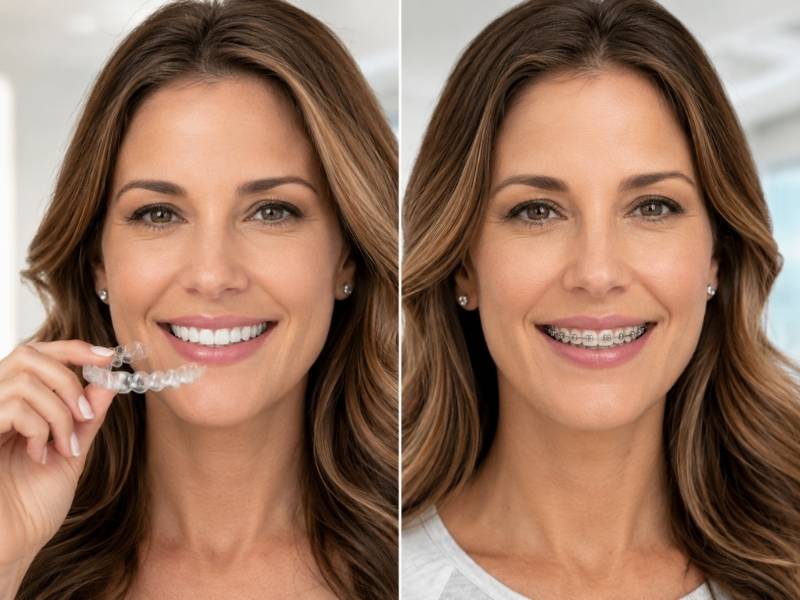

Straightening teeth as an adult is more common than most people realize. According to the American Association of Orthodontists, approximately one in four orthodontic patients today is an adult, and that number has been growing steadily for over a decade. The reasons vary: people who had braces as teenagers but did not wear their retainers, adults who never had access to orthodontic treatment when younger, or patients who completed other cosmetic dental work and now want their alignment to match the rest of their smile.
The most frequent question that follows once someone decides to move forward is straightforward: Invisalign or braces?
Both options work. Both have meaningful advantages. The better choice depends on your specific bite issue, your lifestyle, how much the treatment timeline matters to you, and honestly, how important appearance during treatment is for your day-to-day professional and social life. This guide breaks down every factor that matters so you can walk into your consultation at Confidental Beverly Hills already knowing the right questions to ask.
What Has Changed in 2026: Why This Decision Looks Different Now
Invisalign technology has advanced considerably since the system first launched. The aligner material is stronger and more precise than earlier generations, the attachments (small tooth-colored buttons bonded to teeth that help aligners grip and apply targeted force) have become significantly more refined, and the range of cases that clear aligners can now treat has expanded meaningfully.
Traditional braces have also continued to evolve. Ceramic brackets that match tooth color, lower-profile metal brackets, and self-ligating systems that reduce friction and sometimes shorten treatment time all represent improvements on what was available even five years ago.
The practical consequence is that the gap between what clear aligners and braces can achieve has narrowed. In 2026, most adult orthodontic cases that could previously only be treated with braces can now be treated with Invisalign in skilled hands. The decision has shifted from “which one can actually fix my problem” toward “which one is the better fit for my situation.”
Invisalign for Adults: How It Works and What to Expect
Invisalign uses a series of custom-fabricated clear plastic aligner trays, each worn for one to two weeks before progressing to the next in the series. Each tray is slightly different from the previous one, applying gentle, precisely calculated pressure to move teeth incrementally toward their target positions.
Treatment planning begins with a digital scan of your teeth rather than traditional impressions. Software generates a 3D model of your projected tooth movement at every stage of treatment, which you can review before any aligner is fabricated. This preview is one of the aspects adult patients consistently appreciate most, because it provides a genuine picture of expected outcomes before committing.
For adults with mild to moderate alignment concerns, treatment with Invisalign typically takes 6 to 18 months. More complex cases involving significant crowding, spacing, or bite correction may run 18 to 24 months or longer. Compliance with wearing aligners 20 to 22 hours per day is the single variable most within the patient’s control, and it is the variable that most strongly affects whether treatment finishes on schedule.
What adults particularly appreciate about Invisalign:
- Aligners are nearly invisible in normal social and professional settings
- They are removed for eating, drinking anything other than water, and oral hygiene
- No dietary restrictions since the aligner is out during meals
- Brushing and flossing proceed normally without navigating brackets and wires
- Office visits are less frequent than with traditional braces, typically every 6 to 10 weeks
Honest limitations to know before deciding:
- Requires genuine discipline about wear time. Patients who remove aligners frequently for convenience will not achieve results on the projected timeline
- Some complex bite corrections, particularly severe rotations of certain teeth and significant vertical movements, remain more predictable with traditional braces
- Attachments bonded to the teeth, while tooth-colored, are visible up close and may affect how invisible the overall treatment appears
Traditional Braces for Adults: What the Experience Actually Looks Like
Modern adult braces are considerably less conspicuous and more comfortable than what most adults remember from childhood. Brackets are smaller and lower-profile. Ceramic or clear brackets are widely available and significantly less noticeable than metal. Arch wires apply lighter, more continuous forces that reduce the soreness associated with older systems.
Traditional braces work through brackets bonded directly to each tooth, connected by an arch wire that is periodically adjusted. The adjustment appointments, typically every four to six weeks, allow the orthodontist to apply the precise forces needed to correct each specific tooth movement. This direct control over force application and direction is the clinical reason that braces still remain the preferred approach for certain complex cases.
For severe crowding, significant overbites, underbites, open bites, or cases requiring substantial vertical tooth movement, braces provide a level of three-dimensional control over tooth movement that even advanced clear aligner systems do not fully replicate in all cases. Research published in peer-reviewed orthodontic literature, including studies indexed on PubMed, consistently documents this distinction for specific case types.
Where braces have a real clinical advantage:
- Severe rotations and crowding requiring complex movements
- Significant bite discrepancies involving vertical dimension
- Cases where patient compliance with wear time is a concern
- Patients who have had previous orthodontic treatment and relapsed significantly
What makes braces more challenging as an adult:
- Appearance during treatment is the primary concern for most adult patients
- Cannot be removed for meals, requiring dietary adjustments (avoiding hard, sticky, and chewy foods)
- Oral hygiene requires more effort since brushing and flossing around brackets and wires takes more time and technique
- Office visits every four to six weeks for adjustments
Side-by-Side Comparison: The Factors That Actually Matter for Adults
| Factor | Invisalign | Traditional Braces |
|---|---|---|
| Appearance during treatment | Nearly invisible | Visible brackets and wire |
| Removable | Yes | No |
| Dietary restrictions | None | Yes (avoid hard, sticky foods) |
| Oral hygiene ease | Normal brushing and flossing | Requires more effort around brackets |
| Office visit frequency | Every 6 to 10 weeks | Every 4 to 6 weeks |
| Average treatment time (adult mild-moderate) | 6 to 18 months | 12 to 24 months |
| Effectiveness for complex cases | Excellent for most; some limits | Broadest range of corrections |
| Comfort | Generally more comfortable | Can cause initial soreness after adjustments |
| Cost in Beverly Hills | $5,500 to $9,000 | $4,500 to $8,000 (ceramic higher) |
| Compliance required | High (22 hrs/day wear) | Built into the appliance |
Cost Comparison: Invisalign vs Braces in Beverly Hills
Cost is consistently a primary consideration for adult orthodontic patients. In Beverly Hills, where clinical expertise and material quality are at the top of the market, both options represent meaningful investments.
Invisalign treatment typically costs between $5,500 and $9,000 in Beverly Hills for a comprehensive adult case. The range reflects case complexity, the number of aligners required, and whether refinements (additional aligner series to fine-tune results) are needed.
Traditional braces with metal brackets typically cost $4,500 to $7,000. Ceramic or clear bracket systems add to this range, bringing it to $5,500 to $8,000 at most Beverly Hills practices.
Dental insurance with orthodontic benefits typically contributes a lifetime maximum, often $1,000 to $2,500, that applies to either treatment type. The American Dental Association recommends confirming orthodontic benefit details directly with your insurance provider before beginning treatment, since coverage varies significantly between plans.
Flexible spending accounts (FSA) and health savings accounts (HSA) can be used for orthodontic treatment, which is worth factoring in if you have access to these accounts through your employer.
Which Is Better for Your Specific Bite Issue?
Mild to moderate crowding: Both options work well. Invisalign is generally preferred by adult patients for this category because appearance during treatment is a frequent concern and the clinical outcomes are equivalent.
Spacing and gaps: Invisalign performs excellently for closing spaces. This is one of the case types where clear aligners are particularly predictable.
Overbite correction: Invisalign with appropriate attachments and elastics can address many overbite cases effectively. Severe overbites may still be more predictable with traditional braces.
Underbite: Moderate underbites can be treated with either system. Significant skeletal underbites typically require evaluation by a specialist and may involve treatment beyond orthodontics alone.
Crowded or overlapping front teeth: Both options address this, though very severe crowding or cases requiring extractions may be more efficiently managed with braces.
Relapse after previous orthodontic treatment: Many adult relapse cases involve relatively limited movement and are well-suited to Invisalign.
The Lifestyle Factor: Why Adults Often Choose Invisalign
For adults in professional settings, the appearance consideration during treatment is not superficial. Client-facing professionals, public speakers, executives, and anyone in roles where professional appearance carries weight consistently report that the removability and near-invisibility of Invisalign aligners allow them to pursue orthodontic treatment without it being a dominant feature of their daily professional interactions.
The ability to remove aligners for important presentations, photographs, or events provides a degree of flexibility that traditional braces simply do not. This matters practically for adults in a way that it generally does not for teenagers.
Equally important is the dietary freedom. Adult social and professional life regularly involves meals and events where avoiding specific foods is inconvenient or socially awkward. Removing the aligner for a business dinner and replacing it afterward is a non-issue. Navigating what you can eat around brackets and wires at the same dinner requires more management.
After Orthodontic Treatment: What Comes Next
Orthodontic treatment, whether Invisalign or braces, produces alignment results that can affect other cosmetic dental plans you may have. Many adults who straighten their teeth discover that their alignment improvement creates the ideal foundation for teeth whitening, porcelain veneers, or a more comprehensive smile makeover. At Confidental Beverly Hills, Dr. Liyan Massaband takes a comprehensive view of smile goals, so orthodontic treatment is planned with your complete aesthetic objectives in mind from the beginning.
Retainer wear after treatment completion is essential regardless of which system you used. Without consistent retainer wear, teeth begin returning toward their original positions. Most adults wear a removable retainer nightly long-term. For patients who prefer a fixed solution, a bonded wire retainer on the inner surface of the front teeth is an option that requires no daily compliance.
For guidance on maintaining your dental results after any cosmetic treatment, our detailed resource on how to maintain results after cosmetic dental treatment covers exactly what you need to know.
If you grind your teeth, bruxism can affect both orthodontic treatment outcomes and retainer lifespan. A custom night guard may be recommended alongside your retainer.
Frequently Asked Questions
Is Invisalign as effective as braces for adults?
For most adult cases including mild to moderate crowding, spacing, and many bite corrections, Invisalign is clinically equivalent to braces in the results it achieves. For complex cases involving severe rotations, significant vertical movements, or major bite discrepancies, traditional braces still offer broader control in some situations. A proper clinical evaluation at Confidental Beverly Hills determines which approach is appropriate for your specific bite.
Can adults in their 40s and 50s get Invisalign?
Absolutely. Age is not a limiting factor for orthodontic treatment in adults. Healthy gum tissue and bone support are what matter clinically, not chronological age. Many adults in their 40s, 50s, and beyond complete Invisalign treatment successfully. The evaluation focuses on your current oral health, not your age.
How long does Invisalign take for adults compared to braces?
Treatment duration varies by case complexity rather than by which system is used. Mild adult cases can complete with Invisalign in as little as 6 months. Moderate cases typically run 12 to 18 months. Complex cases may take 18 to 24 months with either system. Braces sometimes treat severe cases more efficiently because of the direct force control they provide.
Does Invisalign hurt less than braces?
Most patients find Invisalign more comfortable than traditional braces overall. New trays cause mild pressure for the first day or two after switching, which resolves quickly. Traditional braces can cause soreness for two to three days after each adjustment appointment, and brackets can irritate cheek tissue during the initial weeks of treatment.
Which is better for crowded teeth in adults, Invisalign or braces?
Both are effective for crowded teeth. Mild to moderate crowding responds well to Invisalign. Severe crowding, particularly cases that may require tooth extractions as part of the treatment plan, is often more predictably managed with traditional braces. This is case-specific and requires clinical evaluation.
What happens if I lose or damage an Invisalign aligner?
Contact your provider immediately. Replacement aligners can be ordered, though this may add cost and delay your timeline. Most Invisalign providers recommend keeping your previous tray as a backup in case a current tray is lost or damaged. Wearing the previous tray temporarily prevents teeth from shifting back while a replacement is arranged.
Ready to Find Out Which Is Right for You?
The best way to determine whether Invisalign or braces is the better path for your specific situation is a comprehensive orthodontic consultation that includes a clinical examination and appropriate imaging. At Confidental Beverly Hills, Dr. Liyan Massaband evaluates your bite in detail and gives you an honest recommendation based on your clinical needs and lifestyle priorities.
Book Your Adult Orthodontic Consultation | Call (310) 858-9212