

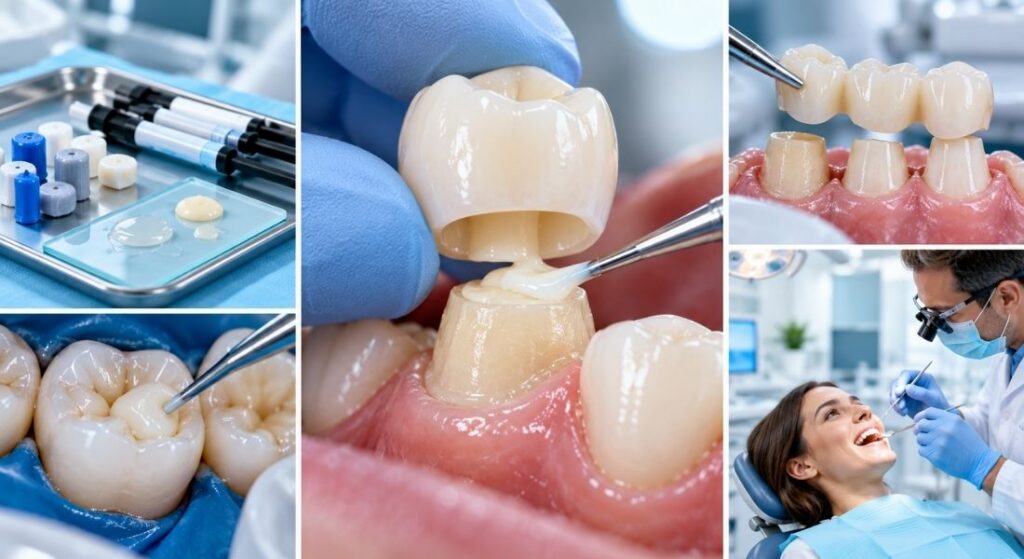

The important part is that different restorations need different cements. A dentist may choose a resin cement for a thin porcelain veneer, a resin-modified glass ionomer for a retentive crown, or a weaker provisional cement for a temporary crown that needs to be removed later. The choice depends on the tooth, the restoration material, the fit, the amount of remaining tooth structure, moisture control, esthetics, and the manufacturer’s instructions.
In this guide, Dr. Liyan Massaband, DMD, MPH explains what dental cement is, how dental cement works, what it is made of, the main types dentists use, how permanent and temporary cement differ, and what to do if a cemented crown or bridge becomes loose.
What Is Dental Cement?
Dental cement, also called a dental luting cement or luting agent, is a material used between a tooth and an indirect restoration. In simple terms, it helps seat the restoration and maintain the connection between the two surfaces. Depending on the formulation, that connection may come mainly from the shape of the prepared tooth, chemical interaction with tooth structure, adhesive bonding, or a combination of these mechanisms.
Patients sometimes search for terms such as tooth cement, teeth cement, dental crown cement, or cement for teeth. These usually refer to the same broad category of professional dental materials, although the exact cement used in the mouth can vary considerably from one procedure to another.
A peer-reviewed review of dental luting cements notes that no single cement is ideal for every clinical situation. Material selection depends on the restoration, preparation, tooth substrate, required retention, and clinical conditions.
How Does Dental Cement Work?
A crown or veneer can look as though it fits directly against the tooth, but there is still a microscopic interface between the two surfaces. Dental cement occupies that interface. The way it holds the restoration depends on the cement system and the surfaces being joined.
Mechanical retention: Some traditional cements harden in the small space between the restoration and a well-shaped tooth preparation. The geometry of the preparation helps resist movement.
- Chemical adhesion: Materials such as glass ionomer and polycarboxylate cements can interact chemically with components of enamel and dentin.
- Adhesive resin bonding: Resin cement can be used with specific primers, bonding agents, and surface treatments to create a strong bonded interface between tooth structure and restorative materials.
- Sealing: A properly selected and placed cement helps close the restoration margin and reduce pathways for saliva and bacteria. The quality of the restoration fit and the cementation technique both matter.
This is why cementation is more than putting a restoration in place. Surface cleaning, moisture control, correct working time, proper seating pressure, curing, and complete removal of excess cement are all part of the clinical process.
Why Do Dentists Use Dental Cement?
Dentists use dental cement because indirect restorations need a stable interface with the tooth or abutment. Depending on the material and treatment, dental cement can serve several purposes at the same time:
- Retain crowns, bridges, veneers, inlays, and onlays in the planned position.
- Fill the thin space between a prepared tooth and an indirect restoration.
- Support a close marginal seal when the restoration is properly fitted.
- Provide adhesive bonding when a restoration depends on bonding for retention, as many veneers and conservative ceramic restorations do.
- Temporarily hold provisional restorations so they can be removed at a later appointment.
- In selected materials, provide additional properties such as fluoride release or lower solubility in oral fluids.
The cement does not replace good preparation design or a well-fitting restoration. A poorly fitting crown cannot be made predictable simply by using stronger cement. Dentists evaluate the tooth, restoration, bite, and margins before deciding how it should be cemented or bonded.
Main Types of Dental Cement Dentists Use
Modern dentistry uses several families of dental cements. The table below gives a patient-friendly overview. It is not a prescription for choosing cement, because product selection depends on the exact clinical case and the restoration manufacturer’s protocol.
| Cement Type | Common Role | Useful Features | Important Limitation |
| Resin cement | Veneers, many ceramic restorations, inlays, onlays, selected crowns and posts | High bond strength, low solubility, useful shade options | Technique sensitive and requires the correct surface treatment and moisture control |
| Glass ionomer cement | Selected crowns, bridges, bands, and other indicated restorations | Chemical interaction with tooth structure and fluoride release | Early moisture exposure and dehydration can affect some formulations |
| Resin-modified glass ionomer | Many retentive crowns and bridges, including selected zirconia cases | Convenient handling, low solubility, fluoride release | Not appropriate for every ceramic restoration or bonding situation |
| Zinc phosphate cement | Traditional metal and metal-ceramic restorations in suitable preparations | Long clinical history and reliable mechanical retention | Does not provide modern adhesive bonding and is more soluble than resin cements |
| Zinc polycarboxylate cement | Selected crowns, bridges, and other conventional indications | Chemical adhesion to tooth structure and relatively good pulpal compatibility | Lower strength and more limited indications than some newer materials |
| Temporary cement | Provisional crowns and bridges or restorations planned for later removal | Designed to hold while still allowing retrieval | Not intended to provide definitive long-term retention |
Resin Cement
Resin cement is widely used when strong adhesive bonding is important. It is especially relevant for many ceramic and porcelain restorations because it can bond effectively when the tooth and restoration surfaces are prepared correctly. Some resin cements are light-cured, some are self-cured, and some are dual-cured. Shade and translucency can also matter when bonding thin restorations in the smile zone.
For patients considering porcelain veneers, the bonding stage is especially important because the cement shade and the ceramic thickness can influence the final appearance.
Glass Ionomer Cement
Glass ionomer cement can chemically interact with enamel and dentin and is known for fluoride release. Dentists may use it in selected restorative and luting situations. It is not automatically the best option simply because it releases fluoride. Strength, restoration type, margin design, and moisture conditions still guide the decision.
Resin-Modified Glass Ionomer Cement
Resin-modified glass ionomer, often shortened to RMGI or RMGIC, combines characteristics of conventional glass ionomer with a resin component. It is commonly considered for many full-coverage restorations when the tooth preparation already has good retention. It offers practical handling and relatively low solubility, but it is not suitable for every ceramic bonding situation.
Zinc Phosphate Cement
Zinc phosphate is one of the oldest conventional dental cements still discussed in restorative dentistry. It mainly relies on mechanical retention rather than adhesive bonding to the tooth. It has a long clinical history, especially with traditional metal restorations, but newer materials may be preferred when adhesive bonding, lower solubility, or specific esthetic properties are needed.
Temporary Dental Cement
Temporary dental cement is deliberately easier to remove than definitive cement. It is often used under provisional crowns and bridges while the final restoration is being made or while the dentist evaluates the tooth, bite, or tissue response. Temporary cements may be eugenol-containing or non-eugenol. When a resin-bonded definitive restoration is planned, a dentist may select a provisional material that will not interfere with the later bonding protocol.
Temporary vs. Permanent Dental Cement
The main difference is not simply that one is weak and one is strong. The real difference is the clinical goal.
Temporary dental cement is intended for a restoration that may need to be removed. It should provide enough retention for normal short-term function without making retrieval unnecessarily difficult.
Permanent dental cement, more accurately called definitive luting cement, is chosen for a restoration that is intended to remain in place. Its retention, sealing ability, solubility, bond strength, and compatibility with the restorative material are considered together.
There is also no single product called the best permanent dental cement. A cement that is appropriate for one crown may not be the best choice for a veneer, a zirconia restoration, a bridge, or an implant-supported crown.
What Dental Cement Is Used for Crowns, Veneers and Bridges?
This is one of the most common patient questions because the word cement is often mentioned during crown or veneer appointments. The answer depends on what the restoration is made from and how much retention is provided by the tooth preparation.
Dental Cement for Crowns
For dental crowns, dentists may use resin cement, resin-modified glass ionomer, glass ionomer, or a conventional cement in appropriate cases. Zirconia, lithium disilicate, metal, and porcelain-fused-to-metal crowns do not all follow the same bonding protocol. The amount of remaining tooth structure and the preparation shape also matter.
A patient-friendly overview of the crown procedure is also available through MedlinePlus, which explains that crown treatment commonly involves a temporary restoration followed by placement of the final crown.
Dental Cement for Veneers
Porcelain veneers usually depend heavily on adhesive bonding. Resin cement is commonly used because it can provide strong retention and allows the dentist to control optical properties such as shade and translucency. The bonding protocol must match the veneer material and the tooth surface.
Dental Cement for Bridges
Conventional fixed bridges may be cemented with different definitive luting agents depending on the bridge material, tooth preparation, span, and retention. Resin-bonded bridges follow a different adhesive concept and should not be treated as though they were conventional full-coverage bridges.
Dental Cement for Implant Crowns
Some implant crowns are cement-retained and others are screw-retained. When cement is used around an implant restoration, complete removal of excess cement is important because retained material below the gum can irritate the surrounding tissues and create a surface that collects plaque. A systematic review of cementation techniques for implant restorations discusses the clinical concern around residual cement and the need for careful cement control.
See the systematic review on excess cement around implant restorations for deeper clinical background.
What Is Dental Cement Made Of?
Dental cement is made from different ingredients depending on the cement family. This is why asking what dental cement is made of does not have one universal answer.
- Resin cements contain resin monomers, filler particles, initiators, and other components that allow the material to polymerize and bond within an adhesive system.
- Glass ionomer cements are based on an acid-base reaction involving fluoroaluminosilicate glass and polyalkenoic acids.
- Resin-modified glass ionomers include glass ionomer chemistry plus resin components.
- Zinc phosphate cement traditionally uses zinc oxide-based powder with a phosphoric acid-based liquid.
- Zinc polycarboxylate cement uses zinc oxide-based powder and polyacrylic acid chemistry.
- Temporary cements may be zinc oxide eugenol, non-eugenol zinc oxide, resin-based, or other provisional formulations.
Manufacturers formulate each material for specific indications, working times, film thicknesses, curing methods, and restorative surfaces. Dentists follow those product-specific instructions because small changes in mixing, moisture, timing, or surface treatment can affect the final result.
How Dentists Choose the Right Cement
A dentist does not choose cement by looking only for the strongest option. In many cases, the correct cement is the one that matches the restoration, tooth, and clinical conditions. Common decision points include:
- Restoration material: Zirconia, glass ceramic, metal, composite, and porcelain restorations may need different surface treatments and cement systems.
- Tooth preparation: A tall, retentive crown preparation may need less adhesive help than a short or minimally prepared tooth.
- Enamel and dentin available for bonding: Veneers benefit from predictable enamel bonding, while heavily restored teeth may present a different bonding surface.
- Moisture control: Some adhesive procedures are more sensitive to saliva or blood contamination than conventional cementation.
- Esthetics: Cement shade can matter under thin, translucent veneers and some ceramic restorations.
- Need for future removal: A provisional restoration or certain implant situations may require retrievability.
- Pulp and tooth sensitivity: The condition of the tooth and depth of preparation influence material and technique choices.
This case-by-case approach is supported by published reviews of dental luting materials. There is no universal cement that performs best for every restoration, which is one reason a clinical exam matters more than a product name alone.
How Does Dental Cement Set or Cure?
Dental cements can harden in different ways. Patients often see a blue curing light during treatment and assume every cement works the same way, but that is not the case.
- Light-cured cement hardens when exposed to a dental curing light. This is useful when enough light can reach the material, such as under many thin ceramic veneers.
- Self-cured cement sets through a chemical reaction after the components are mixed or activated.
- Dual-cured cement uses both light activation and a chemical setting mechanism. This can help where light cannot fully penetrate a thicker or less translucent restoration.
- Acid-base cements, including conventional glass ionomer and zinc phosphate, harden through chemical reactions that do not depend on a curing light.
The blue dental curing light is visible light, not the same thing as ultraviolet light. The dentist also allows the material to reach the stage needed for cleanup, finishing, and normal function according to the specific product instructions.
Is Dental Cement Safe? What Side Effects Can Occur?
Dental cements used by dentists are designed for oral use, but no dental material should be described as completely free of possible reactions. Most patients tolerate cementation without a problem. When symptoms occur, they are often related to the tooth preparation, bite, exposed dentin, gum irritation, or the overall restorative procedure rather than the cement alone.
Possible short-term issues can include:
- Temporary sensitivity to cold, pressure, or sweets after a crown or other restoration is placed.
- Mild gum irritation if tissue was manipulated during treatment or if excess cement remains near the margin.
- A feeling that the bite is high or uneven, which may require a small adjustment.
- Rare sensitivity or reaction to a specific material component.
If you want a broader recovery guide, see what to expect after a restorative dental procedure. Worsening pain, swelling, a loose restoration, or pain when biting should be checked rather than assumed to be normal sensitivity.
How Long Does Dental Cement Last?
There is no useful single number for how long dental cement lasts. Temporary cement is designed for limited use, often while a provisional restoration is in place. Definitive cement is intended to support a long-term restoration, but its lifespan cannot be separated from the crown, bridge, veneer, tooth preparation, bite, and oral environment around it.
Factors that can affect long-term retention include:
- Fit and design of the crown, bridge, veneer, inlay, or onlay.
- Type of cement and whether it was used for the correct indication.
- Moisture or contamination during adhesive cementation.
- Amount of healthy enamel and dentin available for bonding.
- Teeth grinding, clenching, or a heavy bite.
- New decay at a restoration margin.
- Cracks or structural changes in the underlying tooth.
- Oral hygiene and regular dental maintenance.
A restoration can come loose because the cement interface failed, but it can also come loose because the crown no longer fits the tooth the way it did originally. Recementing is appropriate only after the dentist determines why the restoration became loose.
Signs a Cemented Crown, Bridge or Veneer Needs to Be Checked
Contact a dentist if you notice any of the following:
- A crown, bridge, inlay, onlay, or veneer feels loose or moves when you bite.
- The restoration has come off completely.
- There is new pain when biting on a previously comfortable tooth.
- You develop persistent sensitivity that is getting worse rather than settling.
- You notice a new gap, rough edge, dark line, bad taste, or odor around a restoration.
- The gum around an implant crown is persistently red, swollen, or bleeding.
For a crown that is already moving or has fallen out, read our guide to missing or loose dental crowns and arrange an evaluation before chewing normally on that tooth.
What Should You Do if a Crown Comes Off?
A loose or detached crown does not always mean the crown needs to be replaced, but it should be examined promptly. The dentist needs to check the tooth for decay, fracture, loss of tooth structure, bite problems, and the condition of the crown itself before deciding whether recementation is safe.
- Keep the crown if it has come out, and bring it with you to the appointment.
- Avoid chewing hard or sticky foods on the affected side.
- Keep the area clean with gentle brushing and normal oral hygiene.
- Do not use super glue, craft glue, or any household adhesive in your mouth.
- If you cannot be seen immediately, an over-the-counter temporary dental repair cement may sometimes be used only as directed on the package and only as a short-term measure. Do not force a crown into place if it does not seat fully or comfortably.
If the exposed tooth is painful, the crown will not seat, or there is swelling, arrange an urgent dental evaluation rather than repeatedly trying to recement the restoration yourself.
Dental Cement vs. Dental Bonding vs. Filling Material
These terms are often mixed together online, but they are not interchangeable.
- Dental cement or luting cement sits between an indirect restoration and the tooth or abutment and helps retain it.
- Dental bonding commonly refers to adhesive systems or tooth-colored composite added directly to a tooth for repair or cosmetic reshaping.
- A filling replaces missing or decayed tooth structure inside a prepared cavity. It is not simply cement used to glue the tooth back together.
If your concern is a cavity or a small area of lost tooth structure rather than a loose crown, read about tooth-colored fillings and how direct composite restorations differ from crowns and veneers.
Can Dental Cement Fix Decay, a Cracked Tooth or an Infected Tooth?
No. Dental cement can help retain a restoration, but it does not treat active decay, remove infection, heal a cracked tooth, or replace missing tooth structure by itself. If the tooth under a crown has decay, the decay has to be treated before the crown is recemented or replaced. If the nerve is infected or damaged, the tooth may need endodontic treatment before a final restoration is placed.
When symptoms suggest deeper pulpal or root infection, your dentist may evaluate whether root canal therapy is needed before the tooth can be restored predictably.
When to Have Dental Cement or a Restoration Checked
You do not need to inspect dental cement at home or replace it on a schedule. Instead, the dentist evaluates restoration margins, movement, bite, surrounding gum tissue, and the condition of the tooth during routine visits. If something changes between checkups, especially looseness, pain, or swelling, schedule an exam sooner.
A routine dental exam is also the best time to check older crowns, bridges, veneers, and large restorations before a small problem becomes an emergency.
Frequently Asked Questions About Dental Cement
What is dental cement used for?
Dental cement is used to retain or bond indirect restorations and appliances, including many crowns, bridges, veneers, inlays, onlays, posts, orthodontic bands, and some implant-supported restorations. The exact use depends on the cement formulation and the clinical situation.
What is the difference between dental cement and dental glue?
Dental glue is an informal patient term. Dentists usually use more specific terms such as luting cement, resin cement, glass ionomer cement, or dental adhesive. Professional dental cements are designed and tested for oral use. Household adhesives are not substitutes.
What is permanent dental cement?
Permanent dental cement usually means a definitive luting material used for a restoration intended to remain in place long term. Resin cement, resin-modified glass ionomer, glass ionomer, zinc phosphate, and zinc polycarboxylate can all serve definitive roles in selected situations. The right material depends on the restoration and tooth.
How does dental cement work?
Dental cement fills the thin interface between a restoration and the tooth or abutment. Depending on the material, retention can come from mechanical locking, chemical interaction, adhesive resin bonding, or a combination of these mechanisms.
What is dental cement made of?
The ingredients vary by cement type. Common families include resin-based cements, glass ionomer cements, resin-modified glass ionomers, zinc phosphate, zinc polycarboxylate, and temporary zinc oxide-based cements. Each has different chemistry and clinical indications.
Can dental cement cause tooth sensitivity?
Some patients notice temporary sensitivity after a crown or other restoration is cemented. The cause may be the tooth preparation, exposed dentin, bite pressure, the condition of the pulp, or the cementation process. Sensitivity that is severe, worsening, or persistent should be examined.
Can a dentist remove permanent dental cement?
Sometimes, but the difficulty depends on the cement and restoration. A conventionally cemented crown may be retrievable in some situations, while a strongly bonded ceramic restoration may need to be sectioned and replaced. Dentists do not try to remove a restoration until they understand why it needs to come off.
Can I use temporary dental cement from a pharmacy on a loose crown?
A pharmacy dental repair cement can be a short-term measure in some situations, but it is not a substitute for treatment. Use it only as directed, do not force the crown into place, and do not use household glue. The tooth should still be evaluated because decay, fracture, or loss of fit may be the real reason the crown came loose.
Does dental cement dissolve over time?
Dental cements have different levels of solubility and water resistance. Modern definitive cements are selected to function in the oral environment, but no material is completely independent of restoration fit, moisture, bite forces, hygiene, and time. A leaking or loose restoration should be evaluated rather than assuming the cement simply wore away.
The Bottom Line on Dental Cement
Dental cement is a small part of a restoration that has a major job. It helps connect crowns, bridges, veneers, and other indirect restorations to teeth or abutments, but the correct cement depends on the material being restored, the shape and condition of the tooth, esthetic needs, moisture control, and whether the restoration should be retrievable later.
The most useful question is not, “Which dental cement is strongest?” It is, “Which cement and bonding protocol are appropriate for this tooth and this restoration?” That decision is made after examining the tooth, restoration, bite, and surrounding tissues.
If a crown, bridge, or veneer feels loose, schedule an evaluation at ConfiDental Beverly Hills before trying to solve the problem with stronger cement. A loose crown assessment can determine whether the restoration can be safely recemented or whether the tooth needs additional treatment first.
About the Author
Dr. Liyan Massaband, DMD, MPH is a California board-certified dentist at ConfiDental Beverly Hills. She earned her bachelor’s degree in Physiological Sciences from the University of Arizona, a Master of Public Health from the University of Southern California with an emphasis on global health and leadership, and her Doctor of Dental Medicine degree from Midwestern University. Her clinical work includes aesthetic, implant, and restorative dentistry.
Clinical note: This article is for patient education and does not replace an examination or an individualized treatment plan. The cement used for a specific restoration should be selected by the treating dentist based on the tooth, restoration material, and manufacturer’s clinical instructions.