


By Dr. Liyan Massaband, DMD, MPH · Last updated: 30 Sept 2026
Quick answer: How long do dental implants take to heal? The gums usually feel comfortable again within 1 to 2 weeks, but the bone needs about 3 to 6 months to fuse with the implant before the final crown goes on. Lower jaw implants often heal toward the shorter end, upper jaw implants toward the longer end. If you also need a bone graft or sinus lift, the full journey can stretch to 9 to 12 months. Most people are back at work within a day or two and eating normally long before the bone has finished healing.
Key takeaways
- There are two kinds of healing: the gums (days to weeks) and the bone (months).
- The bone phase is called osseointegration, and it is the reason implants take time.
- Soreness and swelling peak around day 2 or 3 and fade over the first week.
- Bone grafts, sinus lifts, smoking and uncontrolled diabetes add time.
- An implant should never feel loose. If it does, call your dentist.
Patients in my chair almost always ask the same thing after their implant consultation: “So when will I actually have my tooth back?” The honest answer is that your mouth will feel normal quite quickly, but your jawbone works on its own schedule. This guide walks you through that schedule, week by week, so you know what is normal and what is not.
Why Do Dental Implants Take So Long to Heal?
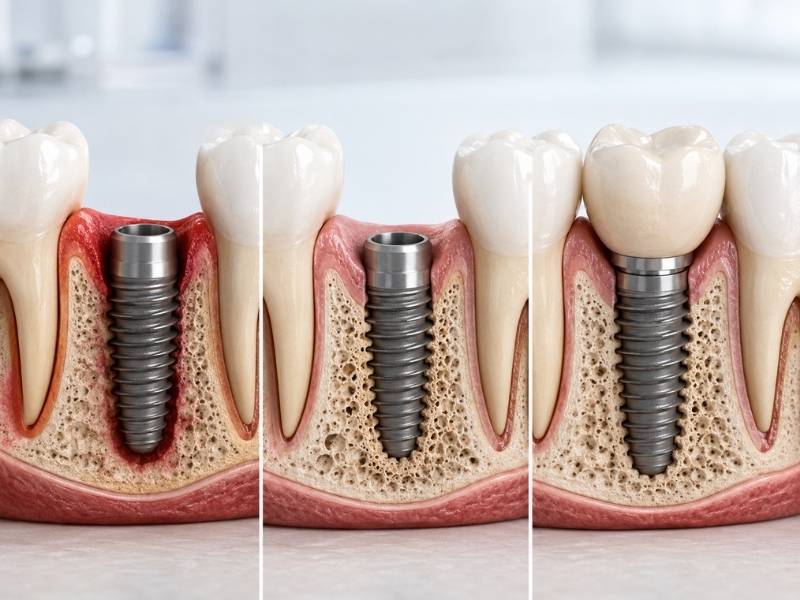
A dental implant is a small titanium (or zirconia) post that replaces the root of a missing tooth. For it to hold a crown and handle years of chewing, your jawbone has to grow onto its surface and lock it in place. This process is called osseointegration.
According to Cleveland Clinic, it takes anywhere from three to nine months for the jawbone to fuse around an implant. The American Dental Association’s MouthHealthy site describes the same three phases: placing the implant, letting the bone heal for several months, then attaching the replacement tooth.
Bone is living tissue, and it simply cannot be hurried. Loading an implant with full chewing force before the bone has bonded to it is one of the most common reasons implants fail. That waiting period is not wasted time. It is what makes a well placed implant one of the longest lasting ways to replace a missing tooth.
Dental Implant Healing Time at a Glance
| Stage | Typical timing | What is happening | What you will notice |
| Surgery day | Day 0 | Implant placed in the jawbone, gums stitched | Numbness for a few hours, light oozing |
| Early healing | Days 1 to 3 | Blood clot forms, inflammation starts repair | Peak swelling and soreness, possible bruising |
| Soft tissue healing | Days 4 to 14 | Gums close over or around the implant | Swelling fades, stitches dissolve or are removed |
| Early bone healing | Weeks 2 to 8 | New bone begins forming on the implant surface | Little or no discomfort, soft to medium foods |
| Osseointegration | Months 2 to 6 | Bone matures and locks the implant in place | Nothing to feel; this phase is quiet |
| Abutment and crown | About months 3 to 6 | Connector piece and final crown attached | Mild gum tenderness for a few days |
| With bone graft or sinus lift | Add about 3 to 6 months | Graft becomes solid bone before or alongside the implant | Longer wait, same steps |
These are typical ranges, not guarantees. Your bone, your health and the number of implants all shift the timeline.
Dental Implant Recovery Timeline: Week by Week
Day 1 to Day 3: the first 72 hours
This is the part most people worry about, and it is usually easier than expected. For a single implant, many patients describe it as similar to or easier than having a tooth pulled.
- Swelling builds over the first 48 to 72 hours, then starts to settle.
- Soreness is usually managed with ibuprofen or acetaminophen, or whatever your dentist has prescribed.
- Light bleeding or pink saliva is normal for the first day.
- Bruising on the cheek or jaw can appear, especially for upper implants or multiple implants.
What helps: cold packs on the cheek (20 minutes on, 20 off) for the first day, sleeping with your head raised, and sticking to cool, soft foods. Do not smoke, spit hard or use a straw, because suction and heat can disturb the healing site.
Day 4 to Day 14: the gums close
By the end of the first week, most people feel close to normal. The gum tissue is knitting together over the implant or around a small healing abutment (a metal cap that shapes the gum while it heals).
- Swelling and bruising fade steadily.
- Stitches dissolve on their own or are removed at a follow-up visit, often around 7 to 14 days.
- You can usually return to warm, soft foods like eggs, pasta, fish and rice.
- Gentle brushing near the site starts again as your dentist directs, along with warm salt water rinses.
Weeks 2 to 8: early bone healing
The gums look healed, but under the surface the real work is just beginning. New bone cells are moving onto the implant.
- Pain should be gone. Any new or worsening pain now is worth a call.
- You can widen your diet, but keep chewing away from the implant side.
- Avoid very hard, sticky or crunchy food on that side (nuts, hard crusts, ice, caramel).
Months 2 to 6: osseointegration
This is the quiet stage. You will not feel the bone fusing, and that is normal. Your dentist may take an X-ray and test how firm the implant is before moving on.
- Lower jaw: the bone is usually denser, so healing often takes about 3 to 4 months.
- Upper jaw: the bone is softer, so healing often takes about 4 to 6 months.
Final step: abutment and crown
Once the implant is stable, your dentist attaches the abutment (the connector) and takes impressions or a digital scan for your implant crown. Placing the crown feels much like getting a regular porcelain crown, with a few days of mild gum tenderness at most.
What Affects How Long Dental Implants Take to Heal?
Two patients can have the same implant placed on the same day and heal on quite different schedules. These are the factors I look at most closely.
- Where the implant goes. Upper jaw bone is less dense than lower jaw bone, so upper implants usually need more time.
- How much bone you have. If a tooth has been missing for a while, the bone shrinks. A bone graft rebuilds it, but the graft needs its own healing time, often a few months, before or alongside the implant.
- Sinus lift. Upper back teeth sit close to the sinus. A sinus lift adds bone beneath it and can add several months to the overall timeline.
- Whether the tooth was just removed. An implant can sometimes go in the same day as a tooth extraction (an immediate implant). Otherwise, the socket is left to heal first, often for 2 to 4 months.
- Smoking and vaping. Nicotine reduces blood flow to the gums and bone. It slows healing and raises the risk that the implant will not integrate. The MouthHealthy guide notes that tobacco use can slow recovery.
- Your general health. Uncontrolled diabetes, some autoimmune conditions, radiation to the head and neck and certain bone medications can slow healing. Tell your dentist about every medication you take, including supplements.
- Gum health. Active gum disease around other teeth can spread bacteria to the implant site, so it should be treated first.
- The number of implants. One implant heals faster and with less swelling than several placed together, or a full arch.
Same Day Implants and All-on-4: Do They Heal Faster?
This is one of the biggest sources of confusion I see. “Same day” implants and All-on-4 let you leave with teeth on the day of surgery, but the bone still needs the same months to integrate.
- You get a temporary tooth or bridge straight away, designed to take light forces.
- You follow a soft diet for several weeks so the implants are not overloaded.
- The final teeth go in once the bone has healed, often after 3 to 6 months.
So same day teeth shorten the time you spend without a tooth, not the time the bone needs. You can read more about full arch options on our All-on-4 dental implants page.
How Long After a Dental Implant Can I Eat Normally?
| Timing | What you can eat | Avoid |
| First 24 to 48 hours | Cool soft foods: yogurt, smoothies (with a spoon), applesauce, lukewarm soup | Hot drinks, straws, alcohol |
| Days 3 to 14 | Soft warm foods: scrambled eggs, pasta, mashed potatoes, fish, oatmeal | Chewing on the implant side, spicy or crunchy food |
| Weeks 2 to 8 | Most softer everyday food, chewed on the other side | Nuts, seeds, hard bread, ice, sticky candy |
| After the final crown | Normal diet | Using teeth to open packets, chewing ice |
Protein, vitamin C, vitamin D and calcium all support gum and bone repair, so a varied soft diet is better than living on milkshakes.
Can I Go Back to Work and Exercise?
- Desk work: most people return the next day or after a weekend, especially for a single implant.
- Physical jobs: allow 2 to 3 days, longer after multiple implants or grafting.
- Exercise: gentle walking is fine after a day or two. Hold off on heavy lifting, running and intense workouts for about 3 to 5 days, because raised blood pressure can restart bleeding and swelling.
- Contact sports: wait until your dentist clears you, and wear a mouthguard.
How to Help Your Dental Implant Heal Well
You cannot speed up the bone, but you can give it the best conditions to do its job.
- Do not smoke or vape, ideally for at least two weeks before and throughout healing.
- Keep the site clean with gentle brushing and the rinses your dentist recommends.
- Take medications as directed, including the full course of any antibiotic you are prescribed.
- Eat well and drink plenty of water.
- Do not poke the site with your tongue or fingers, and do not chew on it early.
- Wear your night guard later on if you grind your teeth. Our custom night guards protect implants from heavy grinding forces.
- Keep every follow-up visit. Your dentist checks healing with X-rays you cannot replace with a mirror.
The American Association of Oral and Maxillofacial Surgeons also stresses following post-operative instructions, good nutrition and follow-up visits as the keys to healthy implant healing.
Is My Implant Healing Normally? Normal vs Call Your Dentist
| Usually normal | Call your dentist |
| Swelling that peaks by day 3, then shrinks | Swelling that grows after day 3 or spreads to the eye, neck or under the jaw |
| Soreness that eases each day | Pain that gets worse after the first few days |
| Pink saliva on day one | Bleeding that will not stop with gentle pressure |
| Mild bruising on the cheek | Pus, a bad taste or a bad smell from the site |
| A small metal cap visible through the gum | Fever or chills |
| Slight tenderness when brushing nearby | The implant or healing cap feels loose or moves |
| Numbness that wears off within hours | Numbness of the lip or chin that lasts past the next day |
Most healing problems are much easier to fix when caught early. If something does not feel right, read our guides to dental implant failure signs and causes and dental implant complications, and call us. Sudden facial swelling with fever should be seen the same day by an emergency dentist.
Planning Your Implant Timeline in Beverly Hills
At ConfiDental Beverly Hills, every implant plan starts with a comprehensive dental exam and 3D imaging, so we can see your bone and tell you honestly whether you will need a graft and how long the whole process is likely to take. We then map out each visit, from placement to your final crown, so there are no surprises about when you will have your tooth back.
If you are comparing options, you may also find these useful:
- Root canal vs implant: which is right for your smile?
- How much do dental implants cost in Beverly Hills?
- Dental implants vs dentures
- Payment options
Ready to find out your own timeline? Book a consultation or call (310) 858-9212. Our office is at 9615 Brighton Way #222, Beverly Hills, CA 90210.
Frequently Asked Questions
How long does it take for dental implants to heal completely?
Most single implants heal completely in about 3 to 6 months, from surgery to the final crown. The gums feel healed within 1 to 2 weeks, but the bone takes longer to fuse with the implant. With a bone graft or sinus lift, the full process can take 9 to 12 months.
How long does it take for a dental implant to stop hurting?
Soreness is usually worst on days 2 and 3 and fades noticeably by the end of the first week. Many people only need over the counter pain relief after the first day or two. Pain that is getting worse rather than better after day 3 should be checked.
How long does swelling last after dental implant surgery?
Swelling usually peaks 48 to 72 hours after surgery and goes down over the next 4 to 5 days. Most visible swelling is gone within a week. Cold packs on the first day and sleeping with your head raised help keep it down.
Do upper implants take longer to heal than lower implants?
Often, yes. The upper jaw has softer, less dense bone, so upper implants commonly need around 4 to 6 months to integrate, compared with about 3 to 4 months for the lower jaw. Your dentist will confirm with an X-ray before placing the crown.
How long after a dental implant can I eat normally?
Stick to soft foods for the first 1 to 2 weeks, then widen your diet while chewing on the other side. You can usually eat normally on the implant once the final crown is in, which is often 3 to 6 months after surgery.
What does osseointegration feel like?
Nothing, for most people. Once the first week or two has passed, the bone quietly grows onto the implant without pain or pressure. Feeling the implant move or throb during this phase is not normal and should be checked.
Can I speed up dental implant healing?
You cannot make bone grow faster than its natural pace, but you can avoid slowing it down. Not smoking, eating well, keeping the area clean, controlling conditions like diabetes and attending every follow-up give the implant the best chance to heal on time.
Is it normal for a dental implant to feel loose while healing?
No. The implant itself should never feel loose. Sometimes the small healing cap on top loosens, which is easy to fix, but either way you should call your dentist promptly so they can check which part is moving.
Does a bone graft make implant healing take longer?
Usually, yes. If the graft is done first, it often needs a few months to become solid bone before the implant is placed. Sometimes the graft and implant can be placed together, which shortens the total time. Your dentist will explain which approach suits your bone.
Can I get a tooth pulled and an implant on the same day?
Sometimes. An immediate implant can be placed straight into a fresh extraction socket if there is no active infection and enough healthy bone. The bone still needs a few months to integrate, but you avoid a separate healing period for the socket.
About the Author
Dr. Liyan Massaband, DMD, MPH leads ConfiDental Beverly Hills. She earned her Doctor of Dental Medicine from Midwestern University and her Master of Public Health from the University of Southern California. In more than 15 years of practice she has completed over 1,000 implant procedures and focuses on full-mouth restoration, complex cases and prevention-first care.
References
- Cleveland Clinic. Dental Implants: Surgery, Advantages, Risks and Recovery.
- American Dental Association, MouthHealthy. Implants.
- American Association of Oral and Maxillofacial Surgeons. Healing Process for Dental Implants.
This article is for general education and does not replace a dental examination. Healing times vary from person to person.